

How we define roles
at Molson Coors
Part 4: How we define roles at Molson Coors
In Parts 1 to 3, we explained how you’re rewarded, how we determine base pay, and how we make pay decisions in a fair and consistent way.
In this part of the series, we explain how roles are defined and organised at Molson Coors and how this connects to how you’re fairly and equitably rewarded.
Delivering fair and equitable pay
At Molson Coors, we’re dedicated to rewarding employees fairly and equitably because it’s the right thing to do.
Our focus on fair and equitable pay in every market we work in guides the policies, processes and decisions we make. This is based on our pay commitments. However, this doesn’t mean paying everyone the same. It means paying equally for work of equal value and ensuring any differences in Total Rewards are for objective reasons, like performance, skills and experience.
Delivering pay equity isn’t something we do once and tick off the list – it’s something we keep working on by regularly reviewing our policies and processes (covered in Parts 1-3) as well as clearly organising jobs and how they connect to each other. Our Job Architecture provides this view of all roles at Molson Coors and how they contribute to the business.


Our Job Architecture explained
Our Job Architecture groups roles together that do similar work with similar skillsets. It is the foundation of our governance and approach to Total Rewards. Many organisations like ours establish, refine and update a Job Architecture to bring clarity, fairness and consistency to how jobs are defined and managed.
Where a job sits in the structure influences its pay range and eligibility for variable pay and benefits. Our Job Architecture delivers:
Scroll over the tiles below to reveal the explanation.

Clarity
ClarityClarity
Everyone understands what roles exist and how they differ. They can see clear career paths for progression via the Job Catalogue to support career growth. Find out more about the Job Catalogue below.

Fairness
FairnessFairness
Ensures similar jobs are paid consistently across the organisation to support fair pay. The structure and processes that sit behind it (such as Job Evaluation) help us to maintain an equitable pay approach as it focuses on role content and contributions, not the jobholder or their title.

Consistency
ConsistencyConsistency
Creates a consistent foundation for people processes (for example, hiring, development and annual compensation planning) helping our company to manage jobs and pay in a clear, fair and scalable way.
Our Job Architecture is made up of a few key building blocks. You’ll see your own position and its Job Family and Job Sub-Family highlighted in the Job Catalogue (find out more below).
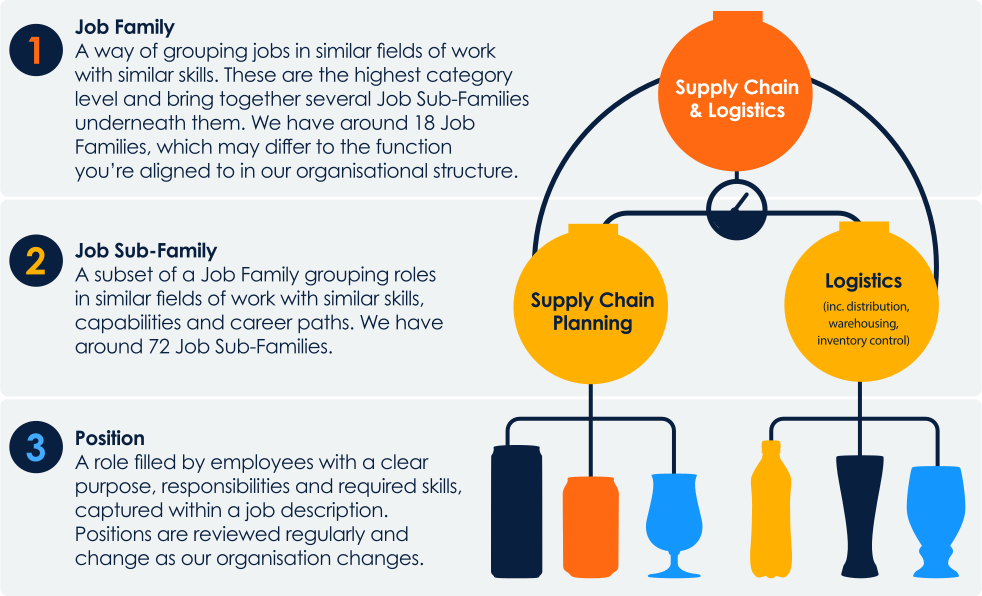
Scroll over the below tiles to find out more about our Job Architecture.
How do we use elements in the Job Architecture?
How do we use elements in the Job Architecture?How do we use elements in the Job Architecture?
We use Job Families and Job Sub-Families as factors in our annual benchmarking process where we look at the value of your role in the external market and how your peers are paid for similar roles.
How do we place a position in the Job Architecture?
How do we place a position in the Job Architecture?How do we place a position in the Job Architecture?
We use job descriptions for each position to place it into the right Job Family, Job Sub-Family and Job Level (GGS). While a job description is not a complete list of all tasks or accountabilities, it should accurately define the position’s key purpose, responsibilities and scope to provide sufficient information to accurately place it in the Job Architecture. Where the position sits influences how we compare the value of the position to the external market and how it compares against a group of similar positions. Where Job Family, Job Sub-Family, Job Level (GGS) and Country are the same, the same Pay Grade Level is applied.
Need a quick refresher on Job Level (GGS) and Pay Grade Level?
Two elements play a crucial role in determining how you are rewarded. Click each one for more details.

Our Job Catalogue
Our Job Catalogue provides a clear, simple and connected view of roles across the business, helping you see where your role sits today and future opportunities to progress your career and expand your Total Rewards potential at Molson Coors. The catalogue supports our focus on transparency by providing a consistent view of our roles, careers, and rewards.
Click on the boxes below to find out more about the Job Catalogue, starting with ‘Introduction to the Job Catalogue’.
Frequently Asked Questions
Select a question below to reveal the response.
Explore some employee scenarios…

Meet
Niko

Role: Account Manager
“I have compared the Hiring Zone for my Job Level (GGS) to others at the same level and I’m surprised about the variation in pay”
- Job Family: Sales and Commercial
- Country: UK
I have the same skills and experience as a colleague in another part of the business at the same Job Level (GGS) with similar responsibilities but lower pay. It didn’t feel fair so I spoke to my manager to understand what I can do to progress my pay.
She explained that each position is mapped to a different Job Family and Job Sub-Family based on the responsibilities outlined in the job description.
While roles may appear similar there are differences that influence the Pay Grade Level. My manager suggested I look to broaden my own expertise and responsibilities as this could unlock opportunities for higher position and pay, potentially in another area of the business.

Meet
Petra
Role: Finance Manager
“I think my job description is inaccurate and therefore mapped to the wrong Job Family”
- Job Family: Finance
- Country: Croatia
My day-to-day role is very different to the roles and responsibilities outlined in the job description, so I raised my concerns with my manager that I’m mapped to the wrong Job Family as a result. I think I should be in Project/Programme Management.
My manager explained that the job description is designed to reflect the core purpose and key accountabilities of a role, rather than every day-to-day task. They’re used to ensure roles are consistently understood and mapped across our organisation.
We also discussed how Job Families are defined and the criteria used for mapping roles. This helped explain why my role is currently aligned to the Finance Job Family rather than Project/Programme Management.

Meet
Almasa
Role: Engineer
“I think I should have the same Hiring Zone as my colleague Maria in Czechia as we do the same role”
- Job Family: Engineering
- Country: Serbia
I compared my role to Maria’s in the Job Catalogue and have seen the Hiring Zone for the role in Czechia is higher, which doesn’t feel fair.
I shared this with my manager in our monthly catchup, and she explained that location is one of several factors that influences how I’m rewarded. As the cost of living is higher in Prague and tax regulations differ from those in Belgrade, pay is also higher. I’m still frustrated but I understand why the difference exists.

Meet
Jessica
Role: Brand Manager
“I think I’m at the wrong Job Level (GGS) or Pay Grade Level (PGL)?”
- Job Family: Brand and Marketing
- Country: Hungary
My Job Level (GGS) is 12 but a colleague doing a similar role with less responsibility in another business/department is at Job Level (GGS) 13.
My manager explained that Job Level (GGS) is assigned based on the role not on the individual, in a process called Job Evaluation. He directed me to this series to understand more about how they’re determined. I now understand why a role in a different business/department would have a different Job Level (GGS).
What’s coming next?
In Part 5, we’ll cover:
- Tips for having an effective Total Rewards conversation with your manager
- What you can do to influence your Total Rewards

